Thursday, September 30, 2010

Coming up this weekend

Hello readers!

September now turns to October. The past week here in Montréal has seen a small but noticeable drop in temperature. I've been seeing my breath at night recently...

The movies coming out these days are piping hot however as some of you may have noticed with my review a few days ago of Denis Villeneuve's Incendies. This weekend offers movie goers two much awaited movies, The Social Network and Let Me In (I particularly enjoy weekends with 2 releases of interest: more excuses to go to the movies!), both of which will be looked at with a fine toothed comb here at Between the Seats. On Sunday the 'Glory of Rome' marathon commences with the 1959 epic, Ben-Hur.

Tuesday, September 28, 2010

Films du Fleur de Lys: Incendies

Incendies (2010, Denis Villeneuve)
A

To say there was buzz surrounding the release of Denis Villeneuve’s Incendies, one is forced to put things into perspective. I haven’t the faintest clue if this film will receive any sort of wider North American release and if it does, it will most certainly quite limited. What’s more, I’d be curious to see how many our neighbouring English Canadian movie goers will have a chance to see the film. Here in Québec, however small a market that may be, there was indeed some moderate hype and anticipation regarding this drama based on the critically acclaimed play from Wajdi Mouawad.

Sunday, September 26, 2010

First Blood Part II rebuttal

Bill, why you didn't you tell me that the horror marathon was starting early this year?

 I think the strongest point you made in your review is that the Rambo franchise should have ended with the first film. First Blood may have been about the downfall of a war hero in a thematic sense, but Part II represents the downfall of that same character in wholly different sense: quality. Watching the first film caused me to wonder where the caricatures of the Rambo character came from. Watching Part II told me exactly where they came from.

Thursday, September 23, 2010

Review: The Descent

 
The Descent (2005, Neil Marshall)
B+

In a very short time span, writer director Neil Marshall has made quite a name for himself. With some directors more time is required for them to hone their skills and fully express themselves through the medium of film and gain a reputation. Marshall’s first film, Dog Soldiers, did him some credit, but it wasn’t until 2005 when his horror film The Descent was released that people really started to take notice. With this second outing, the Englishmen had provided some life into the horror genre at a time when many, including myself, were mostly shunning the supposedly scary motion pictures that studios were releasing.

Tuesday, September 21, 2010

October plans: The Glory of Rome

'Rome is the light.'

Between the Seats often goes against the grain, sometimes willingly other while other times not. Take for instance the plethora of blogs and sites that spent the better part of September covering the always exciting Toronto International Film Festival. The event sounded like plenty of fun and many of the blogs I trust did a splendid job of providing the willing readers with insightful commentary. Time and work proved to be the enemy in our case, so we stayed home and wrote about Rambo and random Asian dramas from the 90s instead.

October is only days away, and I suspect that many of my friends from the blogosphere will be offering reviews an commentary on their favourite horror films (Bill at his Movie Emporium makes it a yearly affair in fact). Well, in this instance, Between the Seats is doing its own thing, but completely on our own will. We all get movie cravings from time to time, and right about now I feel like watching a bunch of action and dramas set in the time of the ancient Roman empire. Some of my favourite films are set during this remarkable and equally savage of human history. There are however some glaring blind spots on my 'watched' list regarding these kinds of movies. So how about we visit a period and place which offered so much beauty and sophistication while also showcasing some Man's most disturbing and grotesque features.

These are the films I'd like to get through so far. Further suggestions are much appreciated!


Sunday, September 19, 2010

Rambo marathon: First Blood Part II


Rambo: First Blood Part II (George P. Cosmatos)
D

The sequel. For many film lovers, sequels are the bane of their existence. For studios, they are the opportunity to cash in on a familiar property which resonates with the paying movie goers. However, unlike what those who snub sequels would prefer to believe, there is planning and execution required in making a sequel. A studio just doesn’t ‘churn out’ another installment in a franchise. However much one might frown on sequels and prequels, there is a writing stage, a pre-production stage, filming, editing, etc. It’s still a movie and it has to get made before shown to an audience. Someone down the production line people (or someone) has to say ‘Alright, this product seems good enough, let’s release it.’ Questions must be posed when facing the challenge of a continuation episode in movies. Do the filmmakers up the proverbial ante? Do they give more of the same? Do they take the characters in a radically new direction altogether? Like I said, it remains a movie and therefore requires time, money and effort in getting made.

Hence, the disappointment that crept in with every further minute of Rambo: First Blood Part II’s running time.

Friday, September 17, 2010

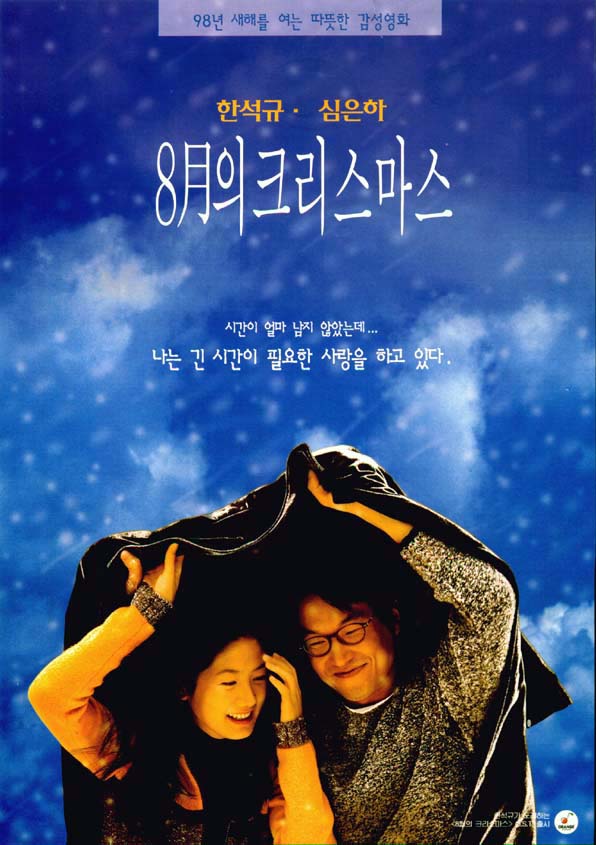
Far East Specials: Christmas in August


Christmas in August
(1998, Jin-ho Hur)
B

I was thinking long and hard about some witty and clever sentence I could use to begin this review of Jin-ho Hur’s romance drama Christmas in August, but such things rarely bear fruit for me. The best I could come up with is that sometimes the best romances are the ones that never were. The notion that two people feel a connection, a bond that perpetually brings them together is something you, I, we can all relate too. In certain instances that bond will develop slowly, taking little baby steps as you and that special someone carefully reveal more about yourself through brief encounters. In other examples, it feels like love at first sight and things move along quickly and passionately. Then comes that first kiss and the declaration, in some fashion or other, of a person’s affections for the other. The end result, we hope, is love. What of those stories that are clearly driven by love but in which the central characters are prevented from ever fully rejoicing in their hopeful union?

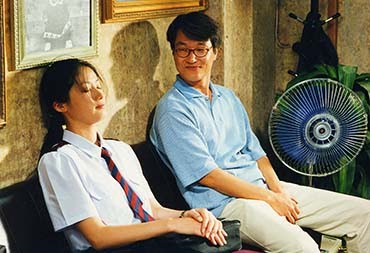
In Christmas in August, the two bashful non-lovers are the owner of a photo studio in his early thirties named Jung-won (played with irresistible charm by Suk-kyu Han) and Darim (Eun-ha Shim), a twenty something traffic cop. On the day Jung-won returns from attending the funeral of his friend’s father, he finds Darim waiting impatiently outside his store. She needs some very specific photos enlarged. What image is captured by the photograph is not important, but there is something, a tiny little something that ignites between the two. It’s quite subtle, and when Darim returns the next to pick up her photos, she and Jung-won begin a little bit of small talk. He rides a moped when travelling to and fro and encounters Darim from time to time, and they share some friendly chit chat. He even offers her a ride one day as she carries some terribly heavy parcels. I think most of you can guess where this is heading, and you’d be correct. They clearly enjoy each other’s company and there are hints that the feelings they hold for one another may run a little bit deeper than mere friendship.

It should be noted that director Jin-ho Hur developed story in a very specific way with what I believe to be a very specific intention. He doesn’t simply want to tell a love story. Rather, he wants to tell Jung-won and Darim’s love story. Their romance blossoms in slow fashion, very slow fashion in fact. Both characters are comfortable with one another, but seem to proceed with baby steps when it comes to true love. We know that Jung-won had a true love at one point in the past (she visits him briefly early in the film), and maybe it is this broken past love that constantly sets up some imaginary barriers whenever the opportunity arises. Let it be known that I don’t refer to ‘imaginary barriers’ in that Jung-won clearly prevents himself from taking any extra steps in order to woo Darim. He just seems bit reserved and bashful at times. I think he really likes Darim but is of the type who believes he had one chance at true love and it failed, so he simply isn’t willing enough to embrace something new. Of course, Darim isn’t much more ambitious in her mannerisms, although she’s the one who asks the more questions (about who is and all) and gives hints that she’d like for them to be something of a couple. So Jin-ho Hur has these two adorable characters come in and out of contact tons of times throughout the film, each time there being a stronger and stronger connection between the two, but again, the increases are incremental. Every once in a while, the viewer sees Jung-won taking some pills and visiting the hospital, so we are warned, rather early on in fact, that all is not quite right with him. When it seems as though he and Darim are about to take the next step, well, the forces that regulate Jung-won’s health have other ideas unfortunately.


I think it’s rather easy to lump Christmas in August into the category of films deemed ‘tearjerkers,’ especially for its final 10 minutes or so, and I should add that it isn’t a category of films that I’m terribly fond of. That being said, I was charmed to a certain degree by this movie. Much of that has to do with Suk-kyu Han’s performance and Jun-ho Hur’s directing. Suk-kyu Han’s Jung-won is such a lovable guy that it’s pretty hard not to like the guy. He isn’t incredibly handsome, he isn’t terribly athletic and doesn’t even show off any kind of remarkable intelligence, but I’ll be damned if I didn’t want to hang around with him for an afternoon (provided I knew how to speak Korean). This man loves to laugh and smile. In fact, he almost reminds me a little of myself in how he reacts to people and things around him. He’ll often shrug or giggle things off in a very nonchalant type of fashion. Not a whole lot gets this guy angry and especially excited, he often just enjoys being nice and cool, all the while showing off that smile. Happy-go-lucky I believe is the term, but thankfully not like Happy go Lucky. The moments when the reality of his health kick in or when people are really trying his patience are jarring because we witness Jung-won’s attitude change dramatically. They don’t occur frequently, but when they do it seems as though he takes on a completely different persona, one diametrically opposed to the one we had explored up until those points. I’m not sure each one works, but at the very least they showed a different side to Jung-won, one indicating that he can be broken down if pushed too far by frustrating circumstances (or when drunk).

As a director, Jun-ho Hur offers a quite affair. In a style reminiscent of so many Korean and even Japanese films I’ve seen recently, he’ll often invite the viewers to saviour the moment, any moment, precisely because the finer details of people can be discovered in those seemingly random and unimportant periods. One can discern much about the psychology of a specific character in these instances. A glance here, a smile there, a sigh of relief, etc. If you enjoy the type of films where some scenes, on a surface level, come across as mundane because they only show someone taking a photograph or preparing a meal in the kitchen, but in reality you know that all the details in the characters’ movements and gestures add to the ‘character building’ aspect of a film, then I’d say Christmas in August is right up your ally. As for myself, it’s a style that only a few years ago I would not have found appealing, but that has quickly won me over. I think it’s a style that, rather than try the audience’s patience, is in fact paying respect to the audience. Movies which are directed and presented in the way Jin-ho hur gives us Christmas in August ( or in the way Kohei Oguri gave Sleeping Man, or how Sang-soo Hong presented The Power of Kangwon Province) know that audiences are more intelligent and discerning than are often given credit for.


Does anything make Christmas in August truly stand out however? I don’t think so. It’s well paced, well acted- nay, really well acted (again, I was struck by Suk-kyo Hun’s charm) and offers plenty of cute little scenes that offer tidbits about who Jung-won and Darim are. The film’s conclusion is…satisfying in many ways, although if one is looking for a more traditional ending to a romance drama, they might leave a bit disappointed. Never did I think the film broke any new ground, but nor did it have to. It sets out to tell a very specific kind of love story, one that reminds how oftentimes ‘life’, in its harsh and unexpected ways, will get into the way of the rosy plans we had.

Wednesday, September 15, 2010

Blogging around (September 15th 2010)


If you are serious movie buff, then it should be no secret that the Toronto International Film Festival (or TIFF for short) is currently taking place. It's arguably one of the most interesting film festivals around in that it successfully balances all sorts of films, from documentaries, to smaller indie films, all the way up to the bigger budget Hollywood dramas that come out in the weeks and months after the festival closes. Plus, it's one of the few notable film festivals which takes place in Canada.

Not being from Toronto, you'll have to forgive me if I don't get the opportunity to follow the festival with a fine toothed comb. However, I have several Torontonian blogger allies who are doing their very best to provide intelligent, fun and thorough coverage of the event, so this week's Blogging Around column will be dedicated to them:

-The Dark of the Matinee, who has some early reviews of such highly anticipated films the likes of Let Me In and 127 Hours.

-Our buddy Corey Atad is also writing away about some of those same movies over at The Reelists.

-The guys from Sound on Sight have plenty to share about. These guys are in fact based in Montréal but, unlike me, invested time, money and effort in getting to Toronto to see the movies.

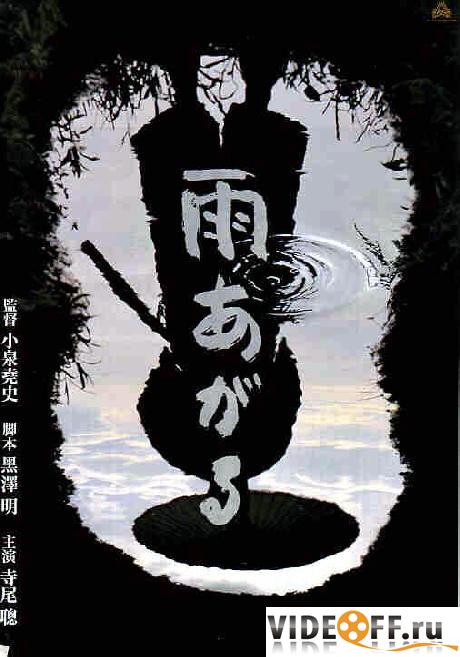
Far East Specials: After the Rain

*Participation in the 1990s Far East Bracket over at the Filmspotting message boards has opened up an entirely new world of Asian cinema was that non-existent to me only a couple of years ago. Not all the movies I stumble upon in this tournament of films prove their worth, but every once in a while luck will share her pretty smile and hand me a little gem, or at least something of note that is inspiring and stays with me for days and sometimes weeks afterwards. Much like I did in the fall of ‘08 and winter of ’09, I’ll be offering some brief thoughts on the noteworthy films I discover throughout the bracket in the hopes that you, the readers, will also be encouraged to dig up some previously unheard of cinematic gems from the Far East. This will hopefully be a recurring article called Far East Specials.


Ame Agaru/ After the Rain (1999, Takashi Koizumi)
B+


For comparative purposes, I would liken the curious beast that is After the Rain to 2001’s A.I. Artificial Intelligence. Steven Spielberg’s unfairly maligned sci-fi drama contained several ideas and story elements that were in fact the brainchild of a great American film director from the past, Stanley Kubrick. In the case of today’s movie, the screenplay was the very last written by Japan’s all time cinema master, Akira Kurasawa, before he passed away. The director, Takashi Koizumi, was Kuroswa’s assistant director for many decades, so one can foresee that there may be stylistic similarities between what this movie shall reveal and the works of Kurosawa.

The story of After the Rain focuses on the travels and small adventures of one ronin (master-less samurai) named Ihei Misawa (Akira Terao), a man with a decidedly uplifting look on life who, while unquestionably talented in bushido, prefers to settle whatever conflicts may arise through gestures of kindness and a warm smile. He stays at an inn with his beloved wife Tayo (Yoshiko Miyazaki) while a heavy rain floods the region. Given the poor weather outside, several other travelers are temporarily stranded at the inn, prompting Misawa to lighten the dour mood with a feast. The importance of these early scene consists mostly of showing off how nice of a guy Misawa is. Shortly after the rain has subsided, our benevolent ronin takes a lonesome walk in the forest, where he encounters a few agitated young samurai students who are about to engage in combat. In the nick of time Misawa defuses the conflict, earning the attention of the clan’s lord, Shigeaki (Shiro Mifune), who was standing not far away. The lord invites Misawa to dinner and offers employment as the clan’s sword master, much to the ire of the other teachers and experienced warriors of the clan.

I haven’t seen all of Akira Kurosawa’s films (that would literally require a few more years at the rate I watch movies), but I have seen a decent amount, and I find the screenplay to After the Rain, which he wrote, to be refreshing. A lot of characters in his films are quite violent and many a time the central figures of his films have had a propensity to violence or agitation. Rather than continuing the tradition of rough and tough samurai heroes, here the hero is shining a different kind of light. I’d even say that with After the Rain, we get the opposite. Ihei Misawa possesses all the skill necessary to dispatch any antagonists in the blink of an eye, much like the great samurai characters of Kuroswa’s previous stories like Sanjuro, but this movie’s protagonist seems naturally gifted with something more important: compassion. He is not a violent man at all even though he could be if he chose to. He smiles a lot, keeps his composure at all times, and often makes an effort to be helpful and decent. The guy is as cool as a cucumber. There is a tenderness to the character of Misawa that was a pure joy to watch because it brought such a different flavour to the samurai genre. I absolutely love samurai films with a heroic protagonist who slices and dices his (or her) way through hoards of villains to restore peace and justice, but the central character of After the Rain is such the antithesis to that formula that I was instantly compelled and charmed by what I was seeing. Even when faced with no other choice than combat, his swiftness and stunning reflexes allow him to avoid his challengers’ blades and subdue them with quick hand to hand moves. I think the one time we see someone actually die by the sword it is accidental and the result of ‘friendly fire.’ There are scenes in which his close rivals are taken aback by his demeanour (which is an odd one for a samurai), only frustrating them more so while Misawa cautiously avoids getting confrontational.

Misawa’s natural inclination to show decency and kindness towards others not only applies to people at the inn or lord Shigeaki, but also his loving wife. Both don’t see eye to eye with regards to Misawa’s use of his skills. Tayo doesn’t necessarily want to be the wife of a ronin, but she loves him for who is he and he often times looks for her forgiveness whenever she learns that he was, willingly or not, involved in some sort of conflict. The film tries to balance these two parallel plot points, the ronin’s involvement in Shigeaki’s clan and his life with Tayo, and I thought it accomplished that rather nicely. Of the Kurosawa films I’ve seen, the women were either not of any significant importance or were actually pretty evil, so here again there was a refreshing change of pace to the plot. Everything returns to this initial idea that Misawa is not your average ronin looking for chumps to gut in order to make a buck…or yen. Even when others take their chances and try to pry some sort of aggressiveness out of him, he just keeps his blood at regular temperature because that’s the way he is, no more and no less.


Koizumi’s direction is controlled and assured, which can be viewed two separate ways. The first is that such a reality comes as a welcome surprise given how he hadn’t been a feature director very often in his career. On the other hand, he was under the wing of Akira Kurosawa for about 28 years, so one would hope that Koizumi acquired some sort of directorial skills after all that work. Still, one can’t lose focus on the fact that this is Koizumi solo, it’s his movie, and his efforts are not bad at all. The film possesses a more classical look and feel to it. The framing in many shots is carefully chosen to focus on very specific objects or people in a given scene, many times remaining static for several minutes so the viewer can inhale the sights and sounds of where conversations are occurring. Whenever the camera performs more dynamic moves, such as panning, I noticed it was very subtle and its intention was merely to follow the action more properly, not necessarily to inject any sort of ‘adrenaline’ into the picture. For a film with a story which develops as calmly as is the case here, After the Rain moves long at a really brisk pace. Of course, it doesn’t quite reach 90 minutes in running length (87 to be precise), so that might have something to do with it, but I was acutely aware of how director Koizumi was handling his scenes. He liked to linger on certain moments, but rarely, if ever indulged. It was often just enough for elements to sink into the viewer’s mind and then move on.

The beauty of the movie is also found in its score, which at first comes across as too sentimental. Hmm, maybe I should choose my words more carefully. I think the score might feel too ‘romantic’ at times, and not in the sense we understand romanticism today. There is a majestic quality (that kind of romance) to the score that required a bit of effort from me to become accustomed to it. I don’t know if it always suited every single scene, but I wouldn’t want to begrudge the film because of it. I do think that, simply as music, it makes for a nice listen, but I hesitate to call it a really good and suitable score.


After the Rain
is more than just a curiosity. It shouldn’t merely be viewed as ‘that Kurosawa screenplay somebody else directed.’ It truly is a very nice movie, which, yes, brought to life Kurosawa’s final script, but also gave Takashi Koizumi to take the spotlight as director for one of the few times in his career. More importantly, it’s a samurai tale that isn’t afraid to give the viewer a radically different vision of what such warriors could be.

Sunday, September 12, 2010

'First Blood' rebuttal


‘You drew first blood, Bill. You drew first blood.’


A commonality between our reactions to Ted Kotcheff’s 1982 First Blood was in how the film blindsided us with its earnest and dramatic tackling of the subject of Vietnam War veterans in the early 1980s. First Blood is not concerned with stereotypical violence as is often found in Hollywood productions featuring actors the likes of Sylvester Stallone. In fact, when the violence erupts, it is atypical in that the character of John J. Rambo is involved in a battle of wits and might against his own countrymen in his own backyard. This alone made for a unique viewing experience, not to mention how, as you put it in your review, Stallone provide some gravitas to Rambo that would have been sorely lacking otherwise. I liked seeing Stallone in an early performance. His youth really lent to his being a disgruntled Vietnam vet who got the proverbial shaft upon his return home from the battle fields. That typical deep voice of his only reinforced Rambo’s unfortunate state of mind and heart throughout the film. The movie works in many ways as a social commentary, one that must have hit American audiences hard back in 1982 when the subject of the Vietnam War was still fresh. The conflicting emotions of the American public towards this infamous war and those who served in it are set on a dangerous collision course in First Blood. For those reasons Kotcheff’s movie is a challenging one, far more challenging than one’s run of the mill action movie, and I think we agree that First Blood is far more than a mere ‘action movie.’

There were a couple of details you mentioned in your review last week that caught me by surprise however, the first being how First Blood ‘isn’t a particularly well made film.’ You go on by briefly mentioning some poor post-production dubbing and the underwhelming direction from Kotcheff himself. With regards to the first point (poor dubbing), I must admit that it flew over my head. Perhaps I was so absorbed in this dark, gritty and challenging world that the fact that dubbing had been performed was too slight detail for me to take notice. I haven’t watched the film since, but I’ll keep that issue in mind the next time I give my disc a spin. It seems to me a lot of older pictures have dubbing, so it could have been that I just took it for granted. More importantly however were your less than complimentary comments towards Ted Kotcheff’s directorial style. I thought his camera did wonders for the film, especially in the action sequences. It certainly has a more ‘old school’ feel to it, with the camera being pretty static in many instances, but oftentimes I thought the frame was perfectly placed and awarded the viewer with some really intriguing images. One of my favourites occurs early on when Rambo is hanging from the cliff over the river. The police have called in a chopper (in which the crazy cop with the rifle is riding) and the hovering vehicle is approaching Rambo’s location along the cliff. The camera is placed very near Rambo, but on his right side, so the rest of the frame showcases the remainder of the canyon and the grey sky. In the background we can see the chopper approaching as Rambo scrambles to keep his grip. I thought that shot was really cool. Not flashy, but really effective at telling the story of an action scene. That was Kotcheff’s most important contribution to the film in my opinion, that is, the ability to carefully frame the shots during moments of tension and action. This might sound ludicrous but I felt there were hints of some Hitchcockian inspiration at times during the action sequences.

The only other point on which we disagree somewhat is the usefulness of the Colonel Trautman (Richard Crenna) character. His importance at the end of the story is of the utmost, that we agree on I believe. However, his introduction around the midpoint of the story does serve some purpose, even though it may not be totally essential. The point I’m about to make has much to do with the type of characters we are dealing with up until the moment Colonel Trautman makes his presence known, so let’s rewind things a little bit. So far, we’ve seen Rambo try to find an old friend, only to discover of his shocking demise. This completely warps Rambo’s attitude, from somewhat decent bloke to cold and distant. When the cops pick him up, they’re aren’t much better. In fact, they’re clearly worse for a short while, mistreating him in some surprising to say the least. This in turn activates ‘killer/survival instinct’ mode in Rambo, with the latter going all army on anyone who dares approach him. The momentary flashbacks tell us one of the main reasons why Rambo is behaving this way, but for some audience members it might not be enough for that knowledge to make Rambo terribly relatable. I mean, we have a United States war veteran maiming small American town police officers in the woods. While I did find the conflict interesting in its oddity and shock value, and while I believe that I could have still found it interesting without the introduction of Colonel Trautman, the Colonel’s presence instils a sort of structure to the chaos that has taken over. We understand a little bit more who Rambo is and why he might be behaving the way he his. In fact, I think the night time scene in which Colonel Trautmen tries to reign Rambo in via radio is top notch. Rambo’s semi-psychotic state is put into some harsh words during their radio conversation (‘They drew first blood’). And anyways, I really enjoyed Richard Crenna's performance, so there.

I was relieved to learn that you found First Blood to be a mostly pleasing viewing experience. It certainly takes the action genre by the horn and gives it good shake. I was listening to the extra features on the disc in which the author of the novel David Morell expresses some of his thoughts. It was quite interesting to hear him reveal that in the book John Rambo really does start gunning people down in small town U.S.A. I think there are some obvious reasons why the decision was made not to have Rambo do that in a mainstream motion picture adaptation, but it had me wondering what sort of movie that would have been like. Regardless, First Blood is far smarter than I foolishly had given it credit for (without having seen it), and you were smart enough to realize this as well. Seems as though things mostly evened out in our reviews. Maybe the real bloodshed will commence next week…

Read Bill's rebuttal over at his Movie Emporium.