Sunday, May 30, 2010

Homemade summer movie marathon: Stray Dog

No, this was not on the list I posted last week which presented a series of summer-type movies that I’d be reviewing over the next couple of months. Still, I hadn’t seen it in a while and I think it possesses at least some of the qualities one would expect from a summer movie: some cops, some drama, some chases, and sweltering heat!


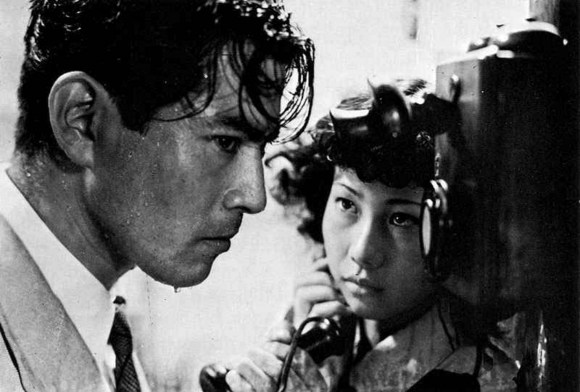
Stray Dog (1949, Akira Kurosawa)
A

On a scorching hot summer day, rookie cop Murakami (the indelible Toshiro Mifune, in one of his earlier silver screen roles) has his not so trusty Colt pistol stolen right under his nose while riding on the tramway. Panic and guilt surge through his slim body upon realizing this embarrassing and grim reality. Hopping off the streetcar, Murakami takes notice of a suspicious looking chap who also just descended from the vehicle. Under the blazing sun, the officer gives chase to the young hoodlum through the dusty streets, but to no avail. Disappointed and ashamed, he returns to headquarters and confesses his situation. While visibly shaken by this event, Murakami’s will and resolve in recuperating the weapon carries through a fascinating journey through the world of petty criminals, a world that shall open his eyes to some far greater realities about post-war Japan.

For some of you who read my ‘100 favourite films list’ from last year, you might recall that I had Stray Dog ranked very high. One of Japan’s greatest film directors (if not the greatest as some put it, plain and simple), Kurosawa, who also had a hand in this film’s script, was the force and often progenitor behind several films which today are heralded as classics. Seven Samurai, Yojmbo, Ran, Rashomon, Ikiru, The Hidden Fortress, these films and more have garnered endless praise over the past few decades. I’ve had the privilege of seeing but maybe a dozen Kurosawa films, but it always been his Stray Dog that captured my arrested my thoughts and senses the most. Almost everything in this movie, from the acting, the editing, to the camera angles, score and pacing has me nodding in approval. Such was the case when I first watched it a little over a year ago, and such was the case yet again as I watched just yesterday. There is something very basic to what Kurosawa does in the film, and I think it is the to the film’s credit. The samurai warriors, castles and armies are still a few years away. There are no kingdoms to save, family legacies to fight for or princess to protect here. The script serves a straightforward and simple story, but one that hides within it thematic complexities that had some serious heft to the movie.

Kurasawa’s directing and the script he is working with propel the film to greater heights than what the viewer appears to be given on the surface. Detective loses pistol, he then vows to search for as long as it takes to recover it with the help of an older partner named Sato (the great Takashi Shimura). Through his trial and error filled adventure, he comes to better understand the world he lives in and his job, or at least a better appreciation of how they function, cruel as they may be. He is young, perhaps a bit on the idealistic side, and certainly stubborn. His story transpires in the few years following the Second World War, a misadventure for which Japan paid a hefty price. While Stray Dog refuses to become a didactic thesis on the war that just passed and its after effects on the Japanese at large, it does venture into some interesting thoughts and possible after effects on certain people, more specifically the young men who partook in the battles and who have returned home. As Murakami and Sato discuss one evening while sharing dinner at the older man’s home, the protagonist and the crook Yusa who possesses his weapon are both product of the ‘après-guerre’ generation, or post-war generation if you will. The war undoubtedly had specific consequences on each of their psyches and philosophies, and one simple event (a stolen bag in the case of both) led to alarmingly different life altering choices for each man. Such dramatic choices made by both, with one, Murakami, opting to serve for the greater good as a detective, and the other, Yusa, recoiling away from honesty and hard work and choosing rather a life of petty crime. I enjoyed the duality of their roles tremendously and thought it pertinent how both men, while not operating on the same level in terms of lifestyle, are products of the same environment. To complicate the dynamics a bit more are the continuous hints that there might exist a softer side to Yusa (who the audience actually doesn’t see until very late in the story). The hoodlum appears to be committing some of his crimes for the sake of a beautiful dancer at a local club, the Blue Bird. He has committed some vile acts, murder being the most heinous, but by the time he and Murakami end their ultimate confrontation, we see that our hero has come face to face with a man who is, in many ways, just as fragile as himself. There are moments in the film, whether through the dialogue or the acting, that may lack a degree of subtlety but generally this theme works magic throughout the plot.


There are some more ideas explored in Stray Dog, such as the juxtaposition of Murakami’s and Sato’s philosophies on criminals and crime in general. Murakami at times feels sympathy towards his prey, understanding that the crook’s actions may result from things beyond his control. Sato denies any sort of pity or empathy towards those he locks away. That isn’t to say he is unkind towards them. There is in fact an interrogation scene in which Sato and an inmate are happily sharing cigarettes and popsicles together, but ultimately he does his duty (putting away the bad people) and moves on to the next case. The intricacies of petty crime are also explored in the early stages of the plot, with Murakami venturing into the seedier locations of the city in order to retrieve his fire arm. The organizing which makes all these crimes possible is quite intricate, with one thread always leading to another. The journey to simply retrieve his darn Colt takes Murakami to a great many places around the city where he faces a surprising variety of dishonest and slimy characters. Very few are noble, most wouldn’t even give him the time of day if he asked for it. This exploration of criminal world, a specific portion of the criminal world (we aren’t talking big time gangsters, this is small time stuff here) is deftly handled by Kurasawa. The heat wave which beats down on everybody adds another element to the entire process. Beads of sweat are shown dripping down everyone’s tired faces. Each step and simple movement seems to require more effort than usual for our heroes and villains. People may feel more glum when it rains, but is it really all that fun when simply taking a step out your front door has you greeted by a heat wave so thick it feels like a brick crashing into your face? I didn’t think so. Just as the case for the stolen Colt heats up, so do the streets (quite literally) where crime never rests. It’s a terrific framing device, one that would be adopted by other directors in the decades to come, most notably American Spike Lee in his seminal Do the Right Thing.

Should much time be spent on the performances, especially the leads? If you have seen any films which featured actors Toshiro Mifune and Takashi Shimura, then you already know that both are more than solid and always up to the task of inhabiting whatever characters the scripts demands. There is something interesting at play here however in that not only are the philosophies of each character different, but so is the overall behaviour of each, and therefore the acting style of both performers. Murakami being the younger, more gun ho detective, Mifune puts some intensity into the role. Throughout his career Mifune has played a great number of characters with very intense personalities, and this earlier role does possess some of that raw energy he is well known for. Interestingly enough, it isn’t only fury or anger along that drive, but also a deep sense of shame, something which struck a chord with me personally. Alongside him is the classy Takashi Shimura who showcases far more restraint, coolness and clever wisdom than his younger counterpart, whom he takes under his wing to solve the frustrating case. This dynamic would be used many times in film again and this specific example of it is, in this reviewer’s opinion, one of the very best.

I could on some more about the qualities of Stray Dog. The editing (specifically the ‘wiping’ from one scene to the next that would become famous with Star Wars), the fluid camera pans which lend several scenes great pacing and dynamism, the supporting cast, etc. Stray Dog is the result of a master filmmaker and storyteller at the top of his game, period. I don’t think I could ever put it more succinctly than that. The only thing left is for you to watch the movie.

Podcasts


Hello again faitful readers!

My Itunes library as well as my Ipod are just about as stuffed with film related podcasts as can be. It's all movies all the time with me! I thought it would be fair to award the podcasts I love some product placement space. Besides I think the members of the list bellow really deserve it. Some of these are well known to web browsers and film buffs, while others may be more like those hidden gems you couldn't believe you haven't discovered until now. Note: the numerical list does not denote any sort of order of 'enjoyment' or 'ranking by quality'. Without further ado:

1-Filmspotting. The godfathers of movie podcasts. A well produced, slick show with two hosts (Adam Kempenaar and Matty Robinson) who are articulate and intelligent at all times. Great variety on the show as well, both in terms of the type of films they discuss and the format.

2-Slashfilm cast: a trio of movie lovers (David Chen, Devindra Hardawar and Adam Quigley) who bring a lof of laughs but also insightful commentary to the table. Always an entertaining listen, even when they're reviewing a Hollywood bomb.

3-Battleship Pretension. Tyler Smith and David Bax tackle a specific movie topic each week (sometimes with a guest) and dissect it as best they can. Their film knowledge is quite impressive and while they can indeed sound pretentious sometimes, it's often just for show...but not always. Fun stuff.

4-Creative Screenwriting. Host Jeff Goldsmith interviews some of the best and brightest screenwriters in the business, from Hollywood and overseas, in this laid back show. I'm a fan of the screenwriting process (after my love for acting) and appreciate the different focus point this show is concerned with.

5-IFC podcast. Hosted by IFC critics and journalists Matt Singer and Allison Willmore share back and forth comments and remarks about a particular topic in film every week. Tremendously laid back podcast. The hosts have a great rapport, often sharing sharing some good laughs while they're at it.

6-The Film Programme. Francine Stock has conversations with the talented actors and actresses in British film, as well as with several film critics, historians and journalists who always keep a sharp eye on cinema from Britain and around the world.

7-Film Junk. Sean, Jay and Greg offer interesting and sometimes less interesting but just damn hilarious comments on the latest Hollywood releases, film news and whatever it is they have been watching over the past 7 days. One of the few Canadian based pocasts I've come across.

8-Mark Kermode and Simon Mayo's Film Reviews. Famous British film critics Kermode and Mayo review and sometimes shred to pieces the latest films released in the UK. Interviews also abound with some fascinating actors and directors from Britain and abroad. Lively and consistently witty.

9-Mad Hatter's Matineecast. A mysterious but friendly figure known only as The Mad Hatter offers film reviews with a guest each week. Very stylish in that each segment has a clever name. Good variety.

10-Left Field Cinema. Host Mike Dawson proposes some unique and non-mainstream films for your film palette. As he states himself, it 'is not film criticism, it's film recommendation and analysis.' I will warn potential listeners that Mike Dawson can be a bit pompous and snobbish in that stereotypical British way, but his commentary is ultimately worth the listen.

11-More than One Lesson. A film podcast hosted by Battleship Pretension creator Tyler Smith. It discusses movies from a Christian perspective. I'm not terribly religious (read: hardly at all) but I think that's partly why I enjoy the show: it simply offers a different take on some movies I love.

12-The Movie Dictator Podcast. The official podcast of The Reelists (who sport a fantastic new look these days) hosted by Corey Atad, Chuck Canzoneri and James Blake Ewing in which one host dictates a film for the other two to watch and discuss. The film is always thematically related to a recent Hollywood release. They're relatively new to the podcasting world, but they've been doing great so far.

The Lamb

Hello readers!

I think a lot of bloggers are familar with the Large Association of Movie Blogs (LAMB), a terrific place to search for some of the most interesting, creative and clever movie blogs around the world wide web. It's a great way to build the movie blog community and I commend the site's efforts in bringing us all together. Well, about a month ago I submitted my application to become a member of their fine community and the request was granted. Between the Seats is offically LAMB member number 553! It just so happens to be my all time favourite number. Not really, but I can always pretend it is.

Strange feelings....

It feels a bit odd not posting anything Star Wars related for the first time in 2 months...Bill and I should do another joint marathon some time in the future.

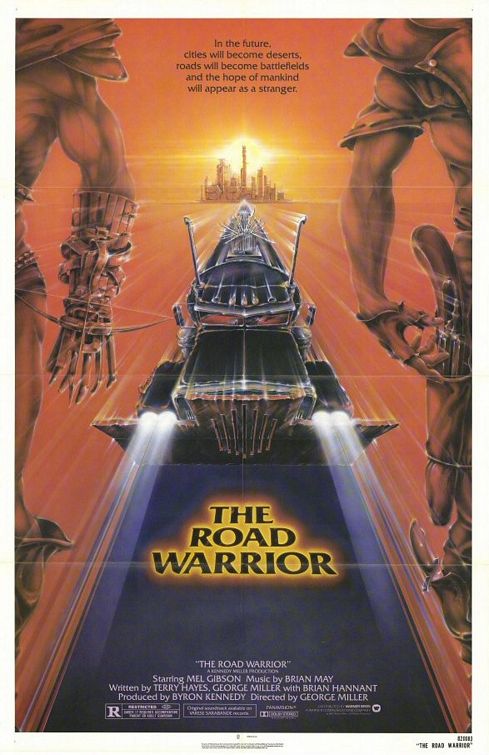
Homemade summer movie marathon: Mad Max


Mad Max (1980, George Miller)
B+

In the not too distant future, somewhere in Australian countryside, the police force and a gang of ruthless and despicable bikers rage an unforgiving war along the open road. When these two forces collide (quite literally at times), rarely does one side have the luxury of leaving the scene alive, or in one piece for that matter, as is terrifically exemplified in the film’s breakneck paced opening sequence. By the look of this world’s general surroundings, technology does not seem to have taken any significant leap forward and even the infrastructure is at times of dubious quality, such as the police station where our protagonist, Max (a young Mel Gibson), is stationed.

No, judging from what the viewer is privy to, about the only things awarded improvements and modifications are vehicles built for speed above all else. If you aren’t ready for the terrors and thrills that await you in this dystopian Australian future, you had better stay home. Such is the peculiar but strangely compelling cinematic vision of director George Miller and his creative team in the cult classic Mad Max, the film that truly started Mel Gibson’s remarkable acting career. The film was made with a modest budget, but the crew were adamant in wanting to give audiences something thrilling which would have them gasping in their seats. Stunts, stunts and more stunts are the chosen ingredients, but with a snippet of story and character development just to add some icing to this devilishly sweet but deadly cake. I greatly admire this kind of filmmaking. It is energetic to the tenth degree, with a pace that doesn’t let up whatsoever. Even though the movie clocks in at a customary 90 minutes, I honestly did not see that hour and a half go by while being transported to Miller’s racing adventure ride. To be perfectly honest, there isn’t much of a story. I don’t mean this in the way we in the world of critics often complain about such high octane action films in that the plot may be overly complicated or needlessly convoluted, what with a series of aimless plot threads making feeble attempts at holding some mess of a story together. On the contrary, Mad Max is as honest an action movie as they come. The opening sequence lasts a good 10 minutes and features about 3 huge crashes with adequately set up the tone and pace of things to come. Even when the movie is doing its best to give some character moments, everything is moving along briskly.

The funny thing about the entire endeavour is that while on the surface it looks like director Miller is more interested is showing off what his crew of filmmakers and very, very brave stunt people can do to earn the appropriate ‘oohs!’ and ‘ahs!’, he also gives the audience a hero, or anti-hero, that is genuinely likable and for whom we can sympathise with once things begin to go horribly wrong for him. Mel Gibson, at least this younger version of the famous Aussie, is pretty darn charming. The film teases us near the beginning that this cop might be a no-nonsense can of bad assery, but just as quickly shows a far more passionate and vulnerable side to the character of Max. He is a family man at heart, with a loving wife and a handsome young baby boy too. He and his partners in the force are hooked on speed and imposing looking vehicles that can help them get that extra edge along the highways, but the movie constantly brings us back to the reality about a man who has a heart and a mind. He is fragile and if you hurt him or his friends, he feels it. I mean it when I say Gibson gives a very nice performance in the film. Quite frankly, based on his Mad Max character and comparing it with some of the other performances of his I’ve seen, I’m fine with going so far as to say this is clearly one of his better acting gigs.

A hero is just as good as the villains he faces off against, and there is no shortage of crazed bikers for our hero to chase after, or be chased by. While lacking in any significant character development or depth, the biker gang’s purpose is to be evil incarnate on wheels. They rarely take any prisoners, are apparently obsessed on imposing their own sense of anarchy, and above all else are not the least bit frightened by the prospect of being chased by the police. Any opportunity to play high speed games of cat and mouse with the authorities seems to be relished by this delusional band. Everyone involved, from the leader to the lowest of the low, is missing some marbles. They babble on endlessly and seem like their hooked on LSD at all times. Subtlety was not on the menu when Miller was guiding the actors who portray the villains, but then again this isn’t a film for which an abundance of subtlety is required. I’m pretty sure we’re just supposed to find these guys weird (check) and appropriately evil (double check). Admittedly I did find some of their behaviour somewhat comical, but one might blame my own uniquely strange sense of humour. If you disagree, you know where to send the hate mail.

Naturally what the film really excels at is destroying cars at completely crazy speeds. For these types of films the camerawork is of utmost importance. It may be all fine and dandy if the stunt drivers rehearsed their performances over and over again until the point of perfection, but if the camera crew and editing department are unversed in the ways of portraying spectacular action on the silver screen, then it was all for nothing. I was more than pleased, and quite honestly thrilled, to witness some epic car and motorcycle crashes that had me reacting with some profanity and gasps the likes of ‘S**t, that must of really hurt’. Solid script be damned, this is for cinema goers looking for high octane action that refuses to pull any punches. I believe the source of my satisfaction from the action oriented sequences is twofold. First are the eventual and inevitable crashes, which are wild and deliciously violent. Second is the sense of speed that is so eloquently captured on film. These are modified cop cars chasing after some very impressive bikes and Miller’s camera is consistently place at strategic locations to convey a marvellous and exhilarating sense of speed that hit me in the face almost every time. Like in so many action films, what the director chooses to do with the camera will make or break a scene. Thankfully virtually every trick and editing technique is used to the fullest extent and provides the film with its some very memorable moments of adrenaline which I won’t soon forget. Oh, and a little bit of extra credit for the eye-popping effect that occurs a couple of times in the film. Funny but fitting as well.

Mad Max could easily be used in a driving instructor’s course. Everything that is done during the 90 minutes of this movie should never, ever be performed in real life while driving a car or a motorcycle. Safety first people, safety first. Who am I kidding? I’m sure you all knew that already of course. Still, I’m not so sure the stunt people thought of safety first upon performing their heroic duties on set. Come to think of it, based on a documentary on Australian exploitation cinema I recently watched on the tele, Not Quite Hollywood, I can confidently tell you that they most certainly did not think about safety first during the filming. In all honesty, if the drivers simply wanted to lend the film a sense of excitement regardless of the costs, they can rest assured that their broken bones were well worth it.

Monday, May 24, 2010

Renoir marathon: La Marseillaise


La Marseillaise (Jean Renoir, 1938)
A

‘Nous sommes les enfants de la patrie.
Le jour de gloire est arrivé!’

One of the great turning points in France’s long history is, unsurprisingly, the French Revolution. A massive gathering of people from across the country who, along the years, grew weary and frustrated with the current state of affairs, a state which awarded the common people petty rights and privileges in the face of the monarch and the aristocracy. Jean Renoir’s elaborate film depicts the period of 1789 to 1792 when the people’s revolution forced King Louis XVI out of the Château de Versailles. We see the historic events through the eyes of many characters, most notably a group of volunteer soldiers from Marseille, the aristocrats, some who fear an impending calamity while other feel reassured by the presence of the Prussian army, and even the king himself, played by Jean Renoir’s brother, Pierre.

Even by late 1930s standards, there is little doubt that director Renoir was thinking big when creating this particular movie. The sets and locations are as varied as they come, the amount of principle characters and secondary roles is impressive, and the amount of costumes, and well as their authentic look, bring a unquestionable gravitas to the project. I was continuously impressed with the grand nature of several scenes, especially those near the end of the picture when the guns go blazing. Fun stuff, to be sure. The title of the film, La Marseillaise, plays a large role in the movie in that the gutsy soldiers we have the pleasure of following are from Marseilles, but that isn’t all. As our band of heroes sign their names on the subscription list, a familiar tune (well, familiar if you’ve ever heard the France national anthem before) can be heard sung from a neighbouring room. This being the first time it is ever sung, one of the soldiers curiously asks his friend who is also waiting in line ‘What’s that guy singing?’ A playful little nod to history in the making which produced a chuckle from me.

Renoir had more than just a few epic scenes to impress the viewers. Indeed, the director opts for a fine balance between small character moments and grand speeches and marches. Rather than concentrate strictly on the grandeur of the proceedings (and potentially getting lost in said grandeur), he delicately tiptoes into the thoughts and feelings of regular folk who chose to sacrifice their lives for the sake of liberty and equality by joining the militia. We get to spend the most time with Jean-Joseph Bomier (Edmond Ardisson) and his friends Javel (Paul Dulac) and Moissan (Jean-Louis Alibert). They are a lively bunch, with Jean-Joseph taking center stage as the more finicky and temperamental member of the band. His emotions may waver a bit much sometimes, but his heart is always in the right place and he chooses to fight alongside his long time friends to defend his beliefs and desires. Edmond Ardisson gives a very entertaining performance. It is a bit showy at times, but I suspect that had more to do with the nature of the character and how it was written. He has some wonderful facial expression with added some terrific range and dynamism to Jean-Joseph. I wouldn’t to say he had a plastic face, that might be going overboard, but the man certainly could inject significant energy into his performance. His patriots in arms are also given some depth by actors Paul Dulac and Jean-Louis Alibert, with Dulac giving his character an interestingly relaxed air given the surrounding circumstances. They make for a genuinely fun band to follow around, and therein lies another one of the film’s strengths: the ability to craft to attaching characters without an overly large amount of backstory. The performances and Renoir’s brisk pacing are sufficient to carry La Marseillaise in the first two thirds.

Love for one’s beliefs, be it country or king, is not only for the regular folk. The story allows the viewer to have a peek into the debates, sometimes heated, from within the aristocracy and the king’s inner circle. Not everyone sees eye to eye, and while most would not want to abandon their place in society if given the choice, some have begun to understand that there may just be some cracks in the system. These scenes are a welcome addition for several reasons. Firstly, it shows that Renoir has the sensibility to not make the antagonists a single minded entity hell bent on crushing the rebellion, which it wasn’t anyways, so we have some sense of realism. But these signs of discord from within the aristocracy also provide a sense of hope in that some people who will be involved in dramatic events which are to follow could opt for a peaceful resolution. History shall dictate otherwise for many others who vowed to defend the monarch, but these scenes in particular lend an interesting dynamic to those we could just as easily lump into the category of ‘antagonist.’ One of the more unique performances in the film is that by Pierre Renoir, who portrays none other than King Louis XVI. His presence is more of a cameo than anything, appearing but during the opening minutes and for about another 5 near the end, but his portrayal is that of a king who is clearly oblivious to the ongoing events within his kingdom and persists with his nonchalant attitude until he is asked to fire up the troops in the Versailles court just prior to the rebellion onslaught. He returns to his quarters a much quieter, subdued man, most likely shaken by the grim reality of what is to follow: a war, probably within his own court yard, with the possibility of his reign coming to an end. Perhaps it is the furious devotion some of the troop members display as he passes them by, a vivacity for something that even as a king Louis XVI has yet to fully understand. Whatever is it, his 10 minutes screen time are worth your time.

Something that embarrassingly failed to strike me as I watched the movie but that felt so obvious once I read a little bit about it afterwards was the timing of the film’s production and release, 1938. The Nazis have been in command of Germany for some years already and are putting remarkable pressure on Europe’s large powers, as well as already dominating some of the continent’s smaller nations. In many ways, and I’m almost certain this was intentional in certain respects, La Marseillaise functioned not merely as a bit of entertaining historic pulp, but also as a rallying cry for the French nation at large, what with the impending actions from Nazi Germany lying ahead. It makes the presence and depiction of the Prussians, who are clearly the most draconian defenders of the French monarch and therefore enemies of the freedom fighters, quite pertinent.

This was a different effort from Jean Renoir. His skills as a visual director are once again there for all to admire, with some fine and smooth camera work and editing giving some character to the storytelling, but Renoir chose to base his film in reality. It was a bold effort and the effort pays off nicely. It may have consisted of propaganda upon its release (and it remains a valuable piece of cinema history because of that), it also works as solid entertainment, with fun performances, some effective crowd rallying scenes and a deliciously action packed climax.

Sunday, May 23, 2010

Star Wars marathon: The X-Wins!


Star Wars awards

Our marathon of films may be over, but there are still some scores to settle. After talking about Star Wars for two months now, let’s take a quick look back at some of the highs and lows of the saga in this once in a lifetime awards show: the X-Wins!
The X-Wins

Best Film: The Empire Strikes Back

Runner up: Revenge of the Sith


Best chase: Pod race from Episode 1

Runner up: Asteroid field chase in Empire Strikes Back)


Best action scene: Detention escape and trash compactor sequence from A New Hope

Runner up: Battle of Hoth


Best performance: James Earl Jones as the voice of Darth Vader

Runner up: Harrison Ford as Han Solo in Episode IV


Best Force use: 'These aren’t the droids you’re looking for' from A New Hope

Runner up: Yoda lifts the X-Wing from Empire Strikes Back


Funniest line of dialogue: ‘I happen to like nice men’ from Empire Strikes Back
Runner up: ‘You don’t want to sell me death sticks. You want to go home and rethink your life’ from Attack of the Clones.


Best demonstration of bad assery: 'Apology accepted, Captain Needa' from Empire Strikes Back
Runner up: Mace Windu takes out Jango Fett in Attack of the Clones)


Best demonstration of heroism: Luke chooses not to join the Dark side in Return of the Jedi
Runner up: Han searches for Luke on Hoth


Best background character we wish we could have seen more/Bobba Fett prize: that jedi with the fucked face and the breathing mask from the prequel trilogy


Runner up:the fat X-Wing pilot from A New Hope (Porky, I think)


Best character/’The Force is strong with this one’ prize: Han Solo
Runner up: Obi-Wan Kenobi in prequel trilogy


Best score: The Empire Strikes Back
Runner up: The Phantom Menace


Best lightsaber duel/Duel of the Fates prize: Luke versus Vader in Empire Strikes Back.
Runner up: Obi-Wan and Qui-Gon Jin against Darth Maul in Phantom Menace)


Most ridiculous character/The Jar Jar prize: that stupid bug character sitting next to Lando in the Millenium Falcon in during the battle of Endor.

Runner up: More bug-like creatures: the Trade Federation leaders.


Worst line: ‘I’m haunted by the kiss that you should never have given me’ from Attack of the Clones
Runner up: ‘Do or do not. There is no try’ from the Empire Strikes Back.

Star Wars marathon: Return of the Rebuttal


Return of the Rebuttal

For all full appreciation of this article, a proper reading of Bill's review of Episode VI over at Bill's movie Emporium is required.

Your review made for on peculiar read last week, Bill. You conclude by stating that Episode Vi is, ultimately, the chapter you favour the least in the entire saga and yet you award a higher grade than for Episode IV. 3 stars isn’t half bad for a film a film you supposedly like less than the one you bemoaned until no end a few weeks back.

Enough with grading systems though. Let us tackle the meat and potatoes of your dissection. It would seem that while we both experienced problems with Episode VI, our respective issues lie with different sections of the movie. You expressed disappointment at how the first two-thirds of the movie feel sluggish and tedious due to the story’s reliance on tying up loose ends. I can think of two loose ends that needed tying up before that climax commences: the rescue of Han Solo from Jabba’a clutches and Luke return to Dagobah in order to complete his jedi training. The former is necessary if the trio of heroes we’ve come to love wants to reunite ever again. It also leads to a solid action sequence where Jabba’s organization is obliterated. True enough, this storyline has next to nothing to do with what follows apart from the goal (rescuing Han), but it’s sufficiently entertaining to earn my attention. The setting of Jabba’s palace and all the bizarre characters inside displays some inventiveness that I find much of the rest of the movie lacks, so there is that. The other loose end concerns Luke’s jedi training and Yoda’s passing. This scene I am less a fan of pretty much for the same reasons you argued. It is a bit tedious, I also find it predictable and the drama found in the dialogue is rather boring. Apart from those two, what other significant loose ends are tied up in the first 2/3 of the movie which add to this tediousness you wrote about?

I was admittedly befuddled by your comments on the character of Leia. You compared her active role in Episode VI to that of Padme’s in Episode III. My opinion on this topic strongly diverges from yours. So much so that I felt that same way I had when reading your ‘slow pace’ comments on Episode IV. Like, wha? Those same complaints were warranted to a certain degree when we discussed Padme participation on Episode III plot. It is true that she did not do as much that time around (being pregnant probably had something to do with it. She was running around all over the place in the previous 2 chapters after all...). But Leia being set in a neutered state and becoming a meek character? She partakes in the rescue mission earlier in the film, gets directly back at Jabba for treating her like a piece of fine meat (oh so fine...), helps lead the rebel troops as they venture through Endor, actually engages in a speeder bike chase like a real hero (while Luke cries ‘Wait! Wait!’ like a little baby) and finally is in the thick of the battle when the Rebels and their teddy bears face off against the stormtroopers. Is it because she wears a dress at one point while the Rebels are resting at the Ewok village that Leia is a meek character? I certainly hope your opinions are not based on such trivial matters. I saw Leia do quite a bit in Episode VI for her to earn some serious style points in my book. Come to think of it, she does far more in Jedi than she did in Empire. Not to mention that the actress Carrie Fisher puts on a fine performance as well. I don’t think she had grown as popular as Harrison Ford at the time so she must have been pretty happy to be there and it shows in her acting. She’s really good. Meek? Hardly.

The climax of the film was showered with praise in your review. Words such as ‘action’ ‘wit’ and ‘epic’ are used, but I wasn’t convinced of 2/3 of those. Yes, there is action in the finale, just as there should be action in the finale of any space opera, but ‘wit’ and ‘epic’ are not two words I’d use to describe the final 30 minutes Episode VI. Try’ ‘uninspired’ and ‘dull’ instead. I went over my thoughts on the space battle already (main issue being the second Death Star) as well as the handling of the Ewoks in the forest battle, so I won’t march another parade about those two topics, but suffice to say that they are both large enough problems for disagreement to pit our two opinions on the climax against one another. I’m unsure as to where you saw ‘wit’ and ‘epic’ in the Ewok battle, especially given how poorly it is filmed, but whatever floats your boat...

I think things do get interesting in the final confrontation between Darth Vader and Luke Skywalker. I briefly touched on Palpatine’s taunting and the attempted seduction of Luke over to the Dark Side of the Force, but I omitted, embarrassingly enough, any thoughts on the actual lightsaber duel. It is a good duel, sort of hybrid between all the battles we’ve seen up until that point. With Vader being in the physical condition he is in one could never anticipate a fight with eye popping acrobatics, but we’re served with a competent sword fight with a decent amount of emotion for a backdrop. About a week after seeing it I can’t say I remember each and every move, but I do recall finding it thoroughly entertaining. I know we discussed the issue of Vader holding back in the comments section of your review, but it did get me thinking about that issue as I prepared this rebuttal. I feel as if the argument can go either way. Thematically, I can see how it makes sense why Vader would feel compelled to hold back (Luke is his son after all), but I think even that notion can be twisted on its head. If I understood correctly, you believe Vader holding back is a hint that Anakin Skywalker is being reborn during those few critical moments late in Episode VI. One can twist that notion around and argue that, yes, Vader did hold back so not to kill Luke....so he can be used later when they turn on the Emporer and ‘rule the galaxy as father and son.’ Vader and Palpatine aren’t stupid, they both how Luke is uniquely powerful and after all those years of being Palpatine’s lapdog, why not go for the top prize when the potential of a powerful and very loyal ally stands right in front of him. Of course, that’s inserting an idea that is in no way hinted at in the film, but still. Or isn’t it? So Vader holds back, fine. What’s up with those few minutes as he watches Palpatine absolutely torch Luke with electric shocks? He wanted his son as an ally, and when that failed, Vader thought it wasn’t worth it anymore. The kid won’t turn so let’s fry him. I also still think the argument that Vader didn’t hold back at all holds water despite that ‘no amount of arguing will ever convince’ you. Luke is still powerful in the ways of the Force and his far more athletically skilled that Vader. Plus, it is there second encounter, so there is the supposition that Luke has learned from his mistakes.

There are no more battle fields for us to confront one another. All the movies have been reviewed and we’ve shared rebuttal articles for each one. Now is the time to dish out some hardware!

Friday, May 21, 2010

Summer is upon us

Hello fellow readers!

I hope you are all enjoying the weather outside. It's that time of year when the temperature rises, with spring turning into summer and those ice cappocinos tasting even more soothing than before. The battles will also be warming up at the box office, what with all the Hollywood mega productions rolling out for the next 3 months.

I thought I'd set Between the Seats' summer plan out right away. If Hollywood can dish out some balls to the wall action and sci-fi movies, so can we. This summer will be looking at some classic as well as some more recent action and sci-fi films. Some of these I have seen, others will be new discoveries, but most should be familiar to the vast majority of readers.

Of course, this being a movie blog of ecclectic tastes, we have to balance things out with some indi cred, right? The 'Jean Renoir marathon' will continue in full stride until I finish up that 3-disc box set I own, and once that is done I'm thinking of going back to a director we discussed for a brief period more than a year ago here...Satyajit Ray (February and March of 2009). That's right, the long-lost Ray marathon will make a comeback. We've already watched his famous Apu Trilogy, but let's explore what else this chap has done!

Below is a list of action and sci-fi films Between the Seats will be looking at all summer long (list is subject to change:


Tuesday, May 18, 2010

Review: Ajami


Ajami (2009, Scandar Copti and Yaron Shani)

B

Sneeking into theatres a few weeks ago was the Israeli film Ajami, a multi-plotline film which explores the tensions and rivialries, based on both enthnicity and religion, in the Jaffa neighbourhood of Ajami. A unique aspect of the filmmaking process, aside from the fact that it was filmed on location in Jaffa, is that it was written and directed by an Isreali Jew (Shani) and an Isreali Arab (Copti). I was pleasantly surprised to learn that a couple of people from two solitudes, as well as creative talents, had managed to combine their forces and create a piece of work directly related to the bittereness which surrounds them everyday.


The trailer had me curious with the simple promise of a solid drama set in Israel and made by Israelis about the Arab, Jewish and even Christian conflicts. If anybody was going to tackle this difficult issue, it might as well have been them. Rather than opting for a simple storyline to drive home an onbvious point, Ajami travels through 5 different storylines and therefore 5 different routes to get to a similar notion: violence, suspicion and hate are unfortunately aspects to life in Ajami which are remarkably difficult to get rid of or avoid. The storylines are varied, but each is in some fashion or another intertwined with the others, be it thematically or because characters of one storyline literally appear in another. A Jewish Cop, a young Muslim man and the Christian girl he fancies, a Muslim boy who must resort to dirty deeds in order to pay for his mother's medical expenses, these are but some of the characters that populate the complicated but competently handled world of the film, a world certainly based on a stark reality.

It is here that I shall make a statement that some might find troubling. Ajami, its strentghs and weaknesses all combined, reminded very much of Paul Haggis' 2005 film Crash. Crash is considered by many people to be one of, if not the worst Best Picture winner at the Oscars, ever. I'm not going to turn this into a review of the Haggis film, but suffice to say that I find that movie to be just fine. Regardless, I couldn't but feel that Ajami was following a very similar strategy which Crash had in order to tackle a very similar if not identical theme: interconnected storylines to discuss and observe racism and ethnic tension. However, I would quickly wager that Ajami is a darker, more somber film than its American counterpart. Directors Copti and Shani do not shy away from showing us just how dangerous the streets of Jaffa can be, with any minute potentially being a person's last, whether or not that person even deserved their untimely demise or not (one of the storylines is set off by the assassination of a wrongfully accused boy). The film doesn't ever show any hints that there may be light at the end of the tunnel for the characters we follow, some of which are easily likeable and whom we would hope to see succeed in their goals. Copti and Shani are smart and more than aware enough that the world these people live in does not always reserve happy endings for them. There were a few moments throughout Ajami when certain characters would see their journeys meet grisly ends and I honestly hadn't seen it coming. I did enjoy this aspect of not knowing who was going to make it out alive or not, which is always a solid way of keeping one's interest in a film of this nature.


I'd also offer some praise to the filmmaking and acting, both of which did a nice job of really bringing a sense of authenticity to the film. Ajami has a documentary style feeling to it, but rather than come off as a gimick, it feels just right for the purposes of the storytelling. In a way it lends a sense that the viewer is right there with the characters on the streets of Ajami. We in the West often see images and videos on the newscasts about conflict in the Middle East and especially in and around Israel, so adopting a variety of cinematography akin to cinéma vérité was a wise and effective choice. The film is devoid of any musical score or soundtrack, notwithstanding any music that might be heard on and off in the background. While I happen to be a great admirer of scores, this would be a time when the absence of such a popular part of the movie watching experience was logical. There is a sufficient amount of tension, wonder and drama to be found in the actions and verbal exchanges of the characters without any music hinting at how the audience should be feeling at any moment. Given how the look and feel of the film was so close to a documentary, I'm not sure how the filmmakers would have fit in a score or soundtrack anyhow. I suspect it would have felt especially artificial in this instance.

The film is not without a few missteps. I wouldn't say they are major flaws in the filmmaking, but they did hold Ajami back from being a great movie. The first and most important were the frequent scenes of people shedding tears. More than once we witness an unfortunate soul learn of the death of a loved one. Of course they should feel sad and cry, but the camera seems to enjoy resting on those moments a bit too much, as if it were inviting the audience to cry along with those characters, which isn't something I buy into very often (read=never). Ajami, as good as it is at depicting the realities of Israeli society and difficulties the ethnicities within that society have in communicating with one another, didn't necessarily blow me away with the 5 storylines. They were all fine, my favourite probably being the one involving the Jewish cop trying to learn what happened to his brother who has vanished. None of the stories are bad, they work on one level or another, but none caught me by surprise with any stunning originality. As is the case with almost all multi-storyline films, you probably won't be as invested in some as you are in others, and this was a slight issue I had with Ajami. Still, I did not outright dislike any of them, it was only that some didn't earn the same interest I had in the others.

I don't know what the realease schedule for Ajami is. I recall seeing a trailer for it at one point in the winter season. I took note of the film's existence, but forgot all about it until I discovered it was playing at a local multiplex which is generous enough to show several international and non-English language movies. If by any chance you happen to stumble upon it, I'd invite you to give it a try. It's quite well made and acted and I have to assume it stays true to the realities on the ground in that region of the world. The message is not one we haven't seen or heard before, and anybody with the smallest interest and knowledge of the situation regarding the various cultures living less than harmoniously in the Middles East today won't find anything terribly new here. But as I've written on many an occasion when reviewing films with less than original plots, sometimes the quality in how a film is presented is more important and effective than what it is presenting.